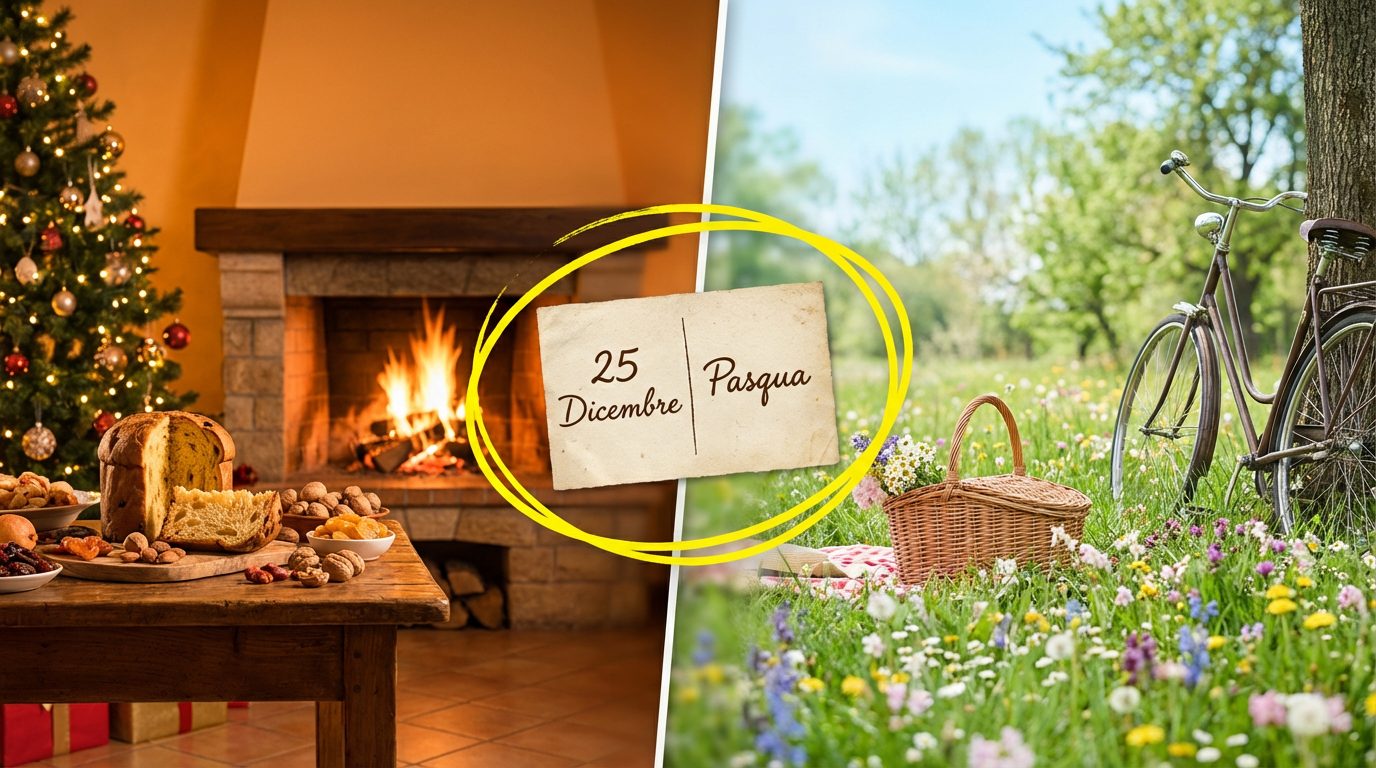
Among the Italian popular sayings that occur most often, “Christmas with your parents, Easter with whoever you want“is most likely the phrase most linked to family and holidays, so deeply rooted that we hear it repeated every year. But where does it come from? In reality, although its origins are not well defined, they are as deep and ancient as Christianity itself. In essence, the proverb contrasts two of the main anniversaries of the Christian calendar according to a logic that reflects the aspects primarily religious, and then cultural and social of Italian society, sinking its roots in a peasant and pre-industrial reality.
The duality between religion and cultural tradition
By definition, Christmas it is a liturgical celebration that does not last just one day, but rather eightstarting with December 25th, the day on which three Christmas masses are held (one at midnight, one in the early morning and one during the day, respectively night, dawn and day), and ending with January 1st, a day entirely dedicated to Mary Mother of God. Christmas marks the birth of Jesus and represents the moment of family celebration par excellence since, traditionally, it is experienced in the home, between relatives and stable loved ones.
On the contrary, Easter, despite having an equally central meaning in the Christian tradition as it celebrates the resurrection of Jesus Christ after his death on the cross, is associated with rebirth and a greater propensity to travel and visit loved ones. In this sense, more specifically, we are talking about experiences shared with friends and loved ones who are not part of the immediate family circle: perhaps the perfect opportunity to organize barbecues, lunches or trips out of town.
It is therefore clear that these two festivals present characteristics that are also reflected in the social rites of those who celebrate them and which influence us closely regardless of religious belief. On the one hand, the Christmas is profoundly marked by symbols of home, preparation and family reunion such as, for example, decorating the tree, building the nativity scene, finding and exchanging gifts, preparing family lunches and sharing traditions that pass from generation to generation. The celebration spiritually represents a moment of stability and return to originsideal for bringing together the deepest bonds around the home, regardless of whether they are blood or emotional.
There Easteron the other hand, is the celebration of the resurrection of Christ, and by its nature there is a tendency to have less “rigid” rules and not restricted to the family circle. Easter turns out to be a celebration mobile in the Gregorian calendar, as it does not have a fixed date, and this mobility is also reflected in its social and metaphorical aspects. They coincide with the arrival of spring, there rebirth of life, The travel from the colder months to the warmer ones, the movement of work outdoors, pilgrimages to places of worship and a succession of traditions and activities that go beyond the daily routine previously created during the winter.
The meaning of the expression
If we want to analyze the meaning more deeply, therefore, “Christmas with yours” is not just an invitation to be with your family, but it is the expression of a long cultural tradition that sees this holiday as a moment of cohesion and rooting. Closing the year among relatives establishes continuity, affection and belonging. At the same time, the dynamics of the proverb are not rigid: with the modernization of transport and the evolution of social models, even Christmas has often become an opportunity for “extended” meetings, trips or holidays shared with emotional groups other than the family of origin.
“Easter with whoever you want”, on the other hand, reflects a greater time relational freedom and social openness spent with old and new friends, as a couple or with people who live far away and who you want to meet, because Easter, in its symbolism of rebirth, welcomes different types of emotional relationships.
The proverb remains so widespread precisely because it crystallizes a way of thinking about anniversaries that has deep roots in Italian cultural history, also thanks to oral transmission and popular stratification.
And who do you celebrate New Year’s Eve with?
The question arises spontaneously where it would fit New Year’s in this scheme, given the existence of the equally widespread variant in various parts of Italy, “Christmas with your parents, New Year with whoever you wantThe answer lies again in the symbolic and social stratification of holidays. Where Christmas represents a fixed domestic occasion and Easter a moment of more dynamic renewal, New Year has always traditionally been a celebration that precedes Christianity and symbolizes the ridedesigned to mark the end of one cycle and the beginning of another.
Its roots go back to ancient Romewhen the New Year (Kalendae Ianuariae) was a rite of social and cosmic transformation. The first day of January was dedicated to Janusthe two-faced god who looks simultaneously to the past and the futureprecisely because the new year marked a moment of transition for the Roman community. The celebrations included exchanges of gifts, banquets, propitiatory acts and moments of extended conviviality and it will not be surprising to learn that they were not strictly limited to the family circle, but rather represented an opportunity to include a wider community serving as a symbolic break from daily habits. In short, there already existed a number of ritual parallels to those that would typically be associated with Christmas.

From here, the variant therefore does not exist “New Year’s Eve with your parents” because the celebration, by its nature, transcends the domestic nucleus and rather invites us to celebrate with those we want to be friends, life partners, extended communities or simply with those we choose to share the entry into the new yearin a new cycle of life full of sharing collective hopes and intentions.
In other words, while Christmas brings us back into the family and Easter leaves us free to choose new paths, New Year invites us to look forward to the future together, whether with relatives, friends or complete strangers at the party. “Christmas with your parents, Easter (or New Year) with whoever you want” it is a way of saying that is able to reflect our social expectations and the perception of anniversaries and holidays, also defining how we organize our bonds during the most important holidays of the year.
