
The yawn it is a universal and ancient behavior, but its meaning has long been misunderstood. The most common explanations, such as the idea that it serves to oxygenate or “wake up” the brain, are not supported by the data. The evidence indicates instead that yawning has above all one social and communicative functionlinked to empathy and the synchronization of behavior between individuals.
What yawning is for and why we do it: science debunks the myths
Yawning is one of the most common and mysterious behaviors we have. We all do it, since before we are born, and we observe it in many animal species. Yet, for centuries, no one has managed to give a convincing answer to a seemingly simple question: why do we yawn?
The most widespread idea is that it serves to “oxygenate the brain”. But science says that’s not the case.
According to a review published in 2010 on Neuroscience and Biobehavioral Reviews by A. Guggisberg and colleagues, the main physiological hypotheses about yawning are not supported by experimental data. The result is surprising: almost all classical physiological explanations they don’t hold up to the data.
Yawning, therefore, is not useful for taking in more oxygen. If we yawn to increase oxygen in the blood, we should do it more when we are under physical stress or when oxygen decreases. But experiments show the opposite: changing the levels of oxygen or carbon dioxide in the blood does not change the frequency of yawning. When the body needs oxygen, it speeds up its breathing — it doesn’t yawn.
Furthermore, yawning is an inefficient way of breathing: deep inhalation is followed by a short apnea, which interrupts gas exchange. In short, if it were created to oxygenate the brain, it would be a rather poorly designed mechanism.
Another very popular idea is that I yawn increase vigilancehelping us stay awake. In reality, EEG studies tell a different story. I yawn appears when we are more sleepyfor example before falling asleep or immediately after waking up. But — and this is the crucial point — it does not produce an increase in brain activation. Indeed, after a yawn the brain continues to show signs of drowsiness.
If it really served to “reactivate” us, we should observe a measurable change in the state of the brain. But this doesn’t happen.
More recently, another hypothesis has been proposed: yawning would serve to cool the brain. Even here, however, the evidence is weak. Available studies cannot separate the effects of temperature from those of drowsiness, which follows similar biological rhythms. And it’s not clear as a yawn can cool the brain better than normal breathing.
The cause of yawning is mainly social
If physiological explanations don’t work, where to look? According to the authors of reviewthe most solid answer is another: yawning is a form of social communication. In many cultures, yawning is associated with boredom, tiredness or light stress. And not surprisingly: yawning signals to others that our internal state is changing. It is not an alarm message, but a “weak” signal, which communicates discomfort or a lack of attention.
This also explains one of the most fascinating aspects of yawning: its contagiousness.
Why is yawning contagious?
In humans, seeing or hearing someone yawn can make us yawn too. But this doesn’t happen always and to everyone. Studies show that:
- the contagious yawn appears only after 4–5 years,
- is reduced in conditions involving empathic difficulties (such as autism and schizophrenia),
- it is more frequent among emotionally close people.
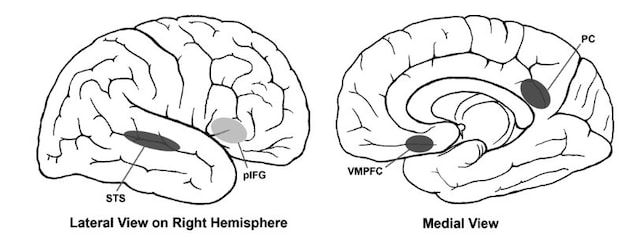
At a brain level, observing a yawn activates the mirror neuron system, and brain areas involved in empathy, social behavior and understanding movements and others. It’s not just a reflex: it’s a deeply social behavior. It must also be said that not all species yawn contagiously. The phenomenon is well documented in humans and large primates, much less (or not at all) in animals with simpler social structures.
Yawning is an ancient behavior, present in many vertebrates. But in social mammals, and especially humans, it seems to have morphed into something more: a group synchronization tool.
According to this vision, yawning does not serve so much to change our internal state, but rather to make it visible to others. And this, from an evolutionary point of view, can make a big difference.
