
One of the first arguments brought forward by those who support the unscientific theory of flat earthism has to do with overflight of Antarctica. The idea is this: if the Earth were spherical then many air routes would have to pass through the South Pole; if this is not done it is because the Earth is not spherical but flat, and Antarctica is nothing more than its border.
Clearly the argument makes no scientific sense: we know the shape of the Earth very well and, certainly, it is not that of a disk. But it’s interesting to understand the reason behind it choice not to fly over Antarcticasince there are basically 4 reasons: the climate, there lack of infrastructure, great circle routes and the field magnetic.
The extreme Antarctic climate
From a technical point of view, flying over the South Pole is no walk in the park: it is one of most hostile places on the planetwith temperatures that can drop even by several tens of degrees below zero – with recorded record values of –89.2°C on the surface (let alone at altitude). To this we must also add incredibly strong winds and frequent snowstorms: in short, a context that is anything but easy to manage.
Be careful though, this doesn’t mean it is impossible fly here: the first flight was successfully completed in 1929 from Richard Byrd and, from that moment, more and more aircraft began to fly over the South Pole. However, things took an abrupt turn a few years later, in 1979when the tourist flight Air New Zealand 901 crashedcausing well 257 victims. The causes of the tragic accident are still the subject of debate: on the one hand there is the version of human error, on the other that of navigation error (more probable). In any case, the result does not change, given that the vehicle hit the Mount Erebus, ending up on the front pages of all the newspapers and pushing many other airlines (especially tourist ones) to change their routes to avoid the Antarctic overflight.
Lack of infrastructure
Another big reason behind the choice not to fly to Antarctica is the situation on the ground: land on ice (especially in case of emergencies) is complex and, as you can imagine, the infrastructure network it is almost absent. This is linked to low demand, given that it is a mostly uninhabited area. And this is a problem.
In fact, there are regulations – such as ETOPS – which indicate how much a twin-engine vehicle (like many airliners, for example) can do away from an airport. This is an essential parameter to be able to manage a possible emergency and in Antarctica it is not always easy to respect, given that the closest airport suitable for this type of situation is located in Chile, to over 3800 km awayand not all aircraft have certifications that can meet these criteria.
The great circle routes
The third point, perhaps the most “obvious”, is that if the planes do not pass through the South Pole it is because the shortest way is another. In fact, on a sphere the shortest route between two points – or in this case, between two cities – is called orthodromy. Well, for most of the routes involving the southern hemisphere this value is increasingly smaller choosing routes that avoid directly flying over the South Pole.
Just to give an example, the Qantas QF63 between Sydney and Johannesburg, which is one of the busiest routes, it is true that it is close to sub-Antarctic and Antarctic regionsbut never crosses the Pole from side to side simply because, in doing so, it would lengthen the road. Obviously this can only be done with suitable means that comply with ETOPS regulations, such as Boeing 787-9 which, with its certification ETOPS-330, can travel 330 minutes flight distance from the nearest airport.
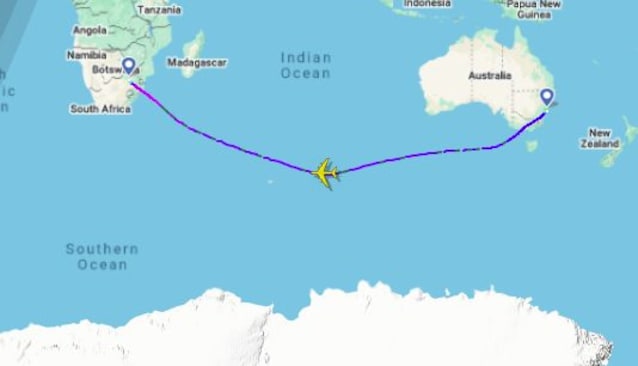
Slightly different matter for all the vehicles that are responsible for bringing i to the continent scientific researchers: in this case the aircraft must physically land here and, for this reason, ad hoc designed means are used, such as theUS LC-130.

The magnetic field at the South Pole
The last aspect, although less impactful, is that relating to magnetic field which, at the South Pole, is almost vertical. This is linked to a physical discussion linked to magnetic field lines, as can also be clearly seen from the image below.
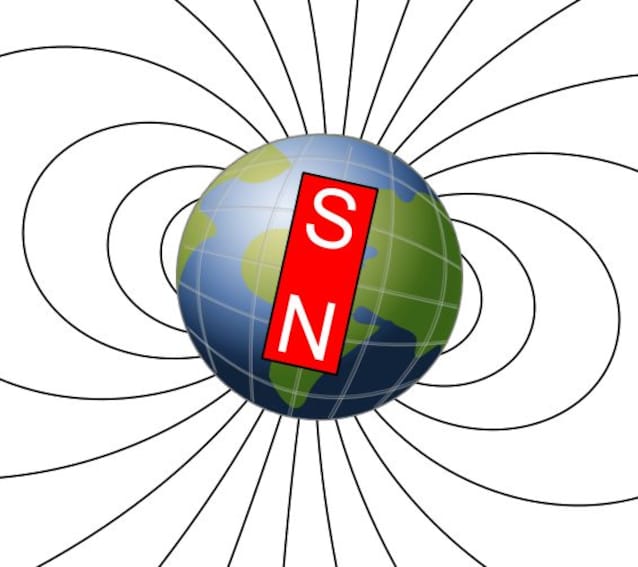
The result is that magnetic compasses fail to function properly here and this, in turn, potentially can interfere with some magnetic navigation systems. Of course, nowadays other systems are mostly used (such as GPS or Inertial Reference Systems), but it is still a possible additional element of difficulty to consider.
