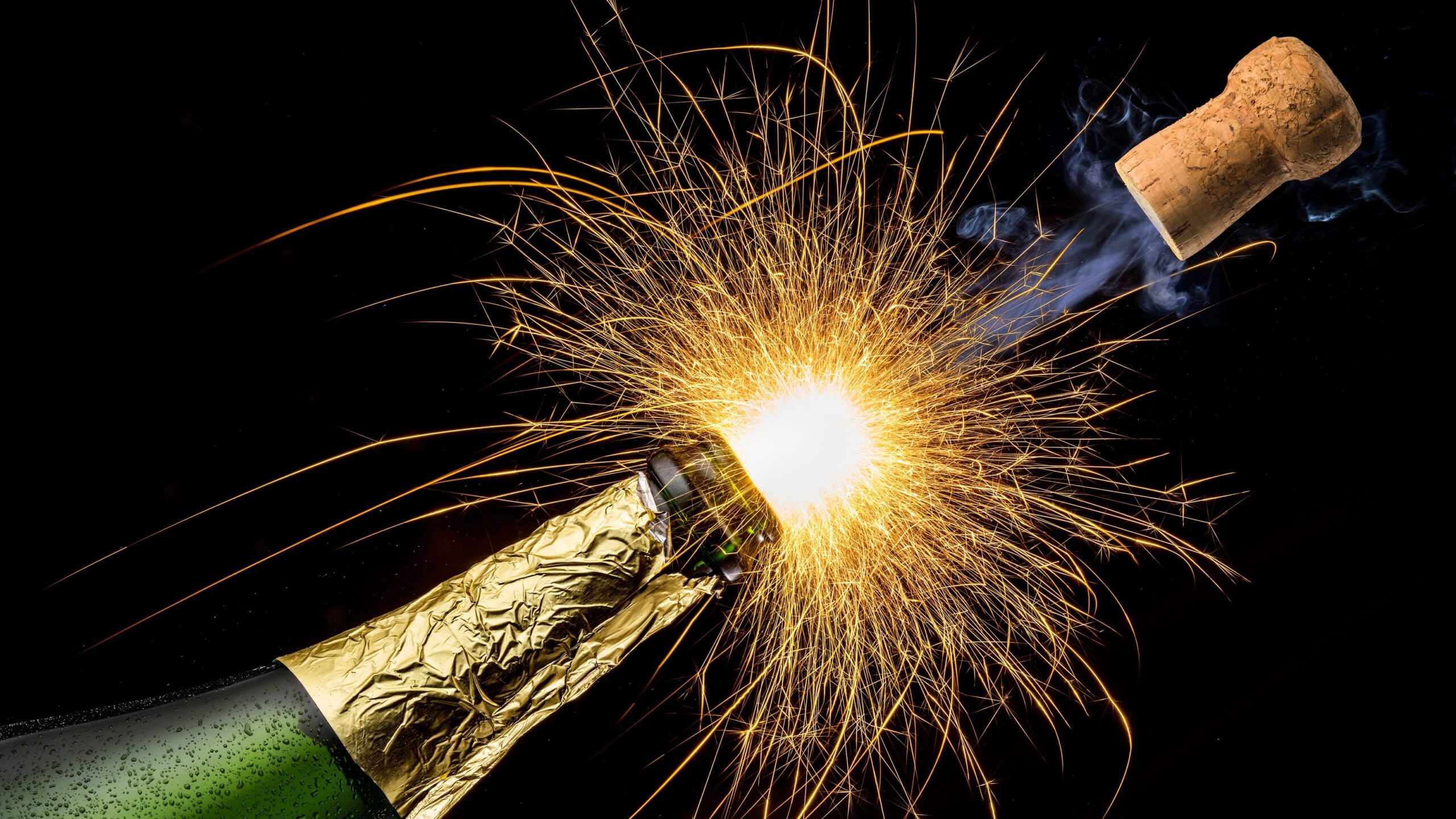
There is no celebration of New Year’s without a nice “bang” made by opening a bottle of sparkling wine. Behind that characteristic “pop”, however, lies all the complexity of fluid dynamics, the physics of fluids: did you know, for example, that the “bang” of uncorked sparkling wine is a miniature version of the sonic boom produced by planes breaking the sound barrier? The noise we hear when we uncork a bottle is in fact, to all intents and purposes, the result of asupersonic shock wave produced by the very rapid expansion ofcarbon dioxide present in the bottle, so to speak the gas that the bottles are made of bubbles which make the wine, precisely, sparkling.
Looking at the bottle you wouldn’t think so, but the pressure of the carbon dioxide in the bottle is several times the atmospheric pressure. The values depend on the temperature of the wine: they can also be reached at room temperature (20 °C). 7.5 times atmospheric pressure. This value reduces to 3-4 times the atmospheric pressure for “fridge” bottles (4 °C). Which is still a higher value than the pressure in the tires of our cars.
Now, we have a gas that is pressing hard on the cap. If he had the chance, he would therefore hear one very strong push to get out of the bottle to rebalance its pressure with atmospheric pressure. The only thing that prevents it is the cork of the sparkling wine, conveniently held in place by its metal cage. But when we quickly remove the cap, the impediment disappears and the gas rushes wildly outwards. As it begins to escape, the carbon dioxide collides with the outside air, thus generating a shock wave that travels at speeds faster than the speed of sound. The noise we hear is exactly this shock wave breaking the sound barrier.
Among other things, as carbon dioxide escapes it expands very rapidly. To be precise, too quickly to have time to exchange heat with the surrounding air. Physicists call this thing adiabatic expansion. The result is that the gas – already cold to begin with – cools drastically. It is this drop in temperature that generates the “cloud” that we observe in the moments following the “bang”.
The very rapid rise is not without its impact on the sparkling wine. First, lose all that carbon dioxide impoverishes the perlage. But not only that: molecules of aromatic compounds that perfume and/or flavor the wine also end up in the violent flow of gas that escapes from the bottle. So in fact uncorking the sparkling wine “with a bang” alters its composition. This does not mean that the “bang” gives a priceless satisfaction!
